

We all need a hero
We all need a hero

The Fitness Dilemma.
The Fitness Dilemma.

Addicted to technology?
Addicted to technology?

Sifu Tony Child
"My kids don't talk to me!"
“My kids don’t talk to me!”
Kids Martial Arts: Magic Bullet?
Kids Martial Arts: Magic Bullet?

Would you like your kids to read more?
Would you like your kids to read more?

Fitness=Happiness for Kids.
Fitness=Happiness for Kids.

Martial Arts Training is not 'just fighting'
Martial Arts Training is not ‘just fighting’
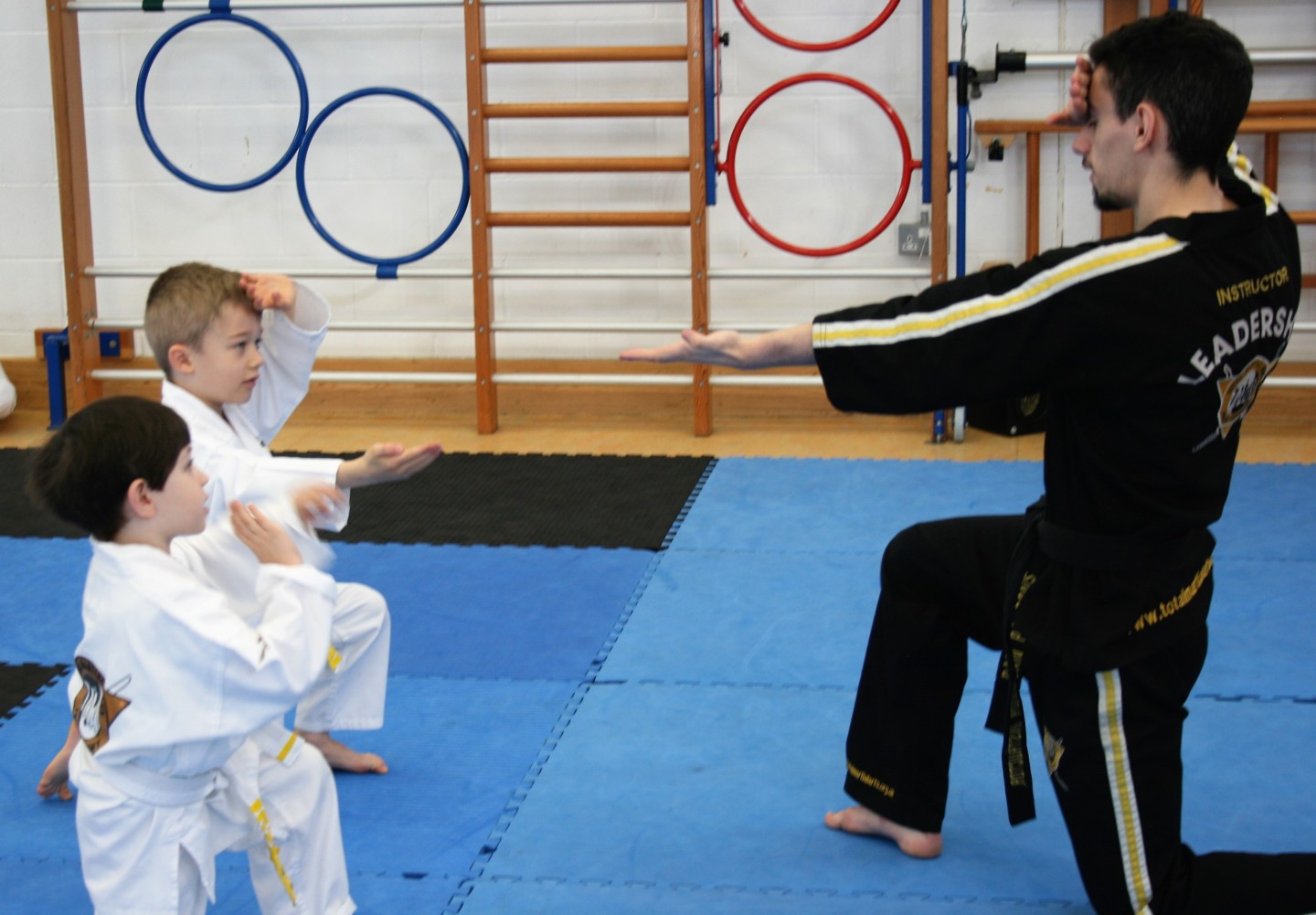
At Total Martial Arts academy in Swindon we talk about developing our junior students holistically or developing the ‘whole person’ rather than ‘teaching people how to fight.’ This article will look a little deeper into What this means.
Some schools say that the sole purpose of training in the Martial Arts is to learn to fight and the rest is just ‘fluff’ and extraneous, but is a ‘fighter’ a Martial Artist?

The majority of our students wanting to learn Martial Arts don’t come to the Martial Arts to learn to fight, 99% of the phone calls we take are from parents who want their children to be confident, fit and to be able to defend themselves. These goals reinforce each other. What’s most likely to kill you? It’s not the street mugger or bully, your own health is most likely to bring you to an early demise, therefore the first rule of self-defence is – look after your health!
If you work on your posture, breathing and mental condition and then exercise sensibly you are likely to stave off the biggest threat to your existence.
To then prevent a lot of trouble in your life you need to work on your ‘emotional intelligence’.
What is ‘emotional intelligence’? An emotionally intelligent person has well developed interpersonal and intrapersonal intelligences, the level of emotional intelligence is an indicator as to how well someone will do in life, they will understand and manage their emotions, be friendly and outgoing, self confident and self motivated, value relationships, be a good team player, listen well, lead others, like to work and learn in groups and set and work towards targets.
Any good Martial Arts Instructor will teach all these aspects and personify the qualities. Think about how much trouble one could avoid by using these skills. Controlling fear and anger, being able to show confidence and deal with other people’s problems in a friendly and natural way are the qualities that can stop violence in its tracks.
It also means that someone with these skills can develop good training relationships, learn faster and get on much better professionally at work.
The author of ‘Maximum Achievement’ Brian Tracey said:
“Today, the greatest single source of wealth is between your ears. Today wealth is contained in brainpower not brutepower.”
The learning parts of the brain are the Neo-Cortex where higher order thinking and problem solving take place and the Limbic System where our emotions and long term memory function – we remember best when we use our emotions in learning.
Under stress we revert to the Reptilian Brain which blocks the Neo –Cortex and Limbic System from thinking and remembering as we are in primitive ‘survival mode’ so learning is slowed down or prevented. This is when we go into a stressed ‘fight, flight or freeze’ mode, losing our temper or panicking. It doesn’t shut down the right hand side or ‘intuitive’ part of the brain so we are still able to react appropriately to dangerous situations and control our emotions. Think of when you are driving and how you intuitively read the road and situations that may occur and react instantaneously without going into panic.
The learning process is also enhanced if proper, permanent learning pathways are used, connecting the information to something that is relevant to the student in a way that excites or stimulates their imagination and emotions in a positive manner, challenging their thinking and making them want to find out more.
Stress should be applied gradually in such a way that the student learns how to deal with it in a positive structured way, using established knowledge, intuition and confidence.
People learn in different ways and the Instructor needs to be able to present the information in a way that they can process. Some respond to visual stimulation, in the form of demonstration, pictures, diagrams and so on, some to auditory, hearing explanations, moving with rhythm, cadence, chanting and sound and some kinaesthetically by practical application, touching, doing and moving.
As a coach, we need to use all three learning styles, but some prefer to learn in one or two of these ways. A good teacher is aware of this and is careful to present the knowledge across all three spectrums.
This is why lesson planning is so important, if the students are aware of what the content and outcome of the lesson is supposed to be, how the knowledge is being given to them, how they are going to process it, how it is going to be practiced, verified and validated, how they will have the opportunity to challenge it and give and get feedback, then they are on track to progress in self development and emotional intelligence. This will give them the overall ability to develop physically and mentally and defend themselves against anything that might influence them in a negative fashion.
Help your Child Perform Under Pressure
Help your Child Perform Under Pressure
At Total Martial Arts Swindon we know one of the primary methods for learning a martial art is repetition. Although our job as coaches is to make classes varied and interesting for the students by disguising the repetition, it is important that we constantly repeat particular actions, movements and sequences over and over again. Research has shown that it takes between 300-500 repetitions to learn a new skill.
We have all heard the phrase ‘practice makes perfect’, but if we can already perform a movement why do we have to continue to go back and keep practicing the same things?
PERFORMING UNDER PRESSURE

Performance Choking: an unexplained sudden drop in performance for no physical reason.
It is necessary to perform under pressure in many areas of life and sometimes that pressure can adversely effect on our skill level. For example, you may find that although you know you can perform a technique well, when asked to demonstrate in front of a group of people it can go wrong or we forget things. This is known as ‘choking’, it is brought on through the stress of performing under pressure.
How are these 2 problems related? It’s all to do with the way we learn. To be the best we can be as martial artists, we need our movements to be instinctive. This will ensure that that we can perform to the very best of our ability, even when under pressure – whether that pressure comes from a crowd of spectators or the threat of an attacker. The key is to understand the learning process. When a junior martial arts student is able to master performing under pressure this will have great benefits in their whole life; achieving results in tests at school and in the workplace later in life.
HOW WE LEARN NEW PHYSICAL SKILLS
There are 2 stages of learning, these are known as Explicit and Implicit.
Explicit learning is the first stage of skill or knowledge acquisition. It relates to how your mind processes new information when learning a task. You receive information and process it into the required action. This action is governed by a part of the brain known as the Prefrontal cortex. At this stage you need to focus and concentrate, putting a lot of thought into your actions (this is called conscious competence). As you practice and develop through repetition the movement becomes automatic, this is the Implicit (second stage) of learning. The control for the action moves to another part of the brain called the Basal Ganglia. This part of the brain is responsible for habits which require no conscious thought (known as unconscious competence) and is a bit like working on auto-pilot, for example blinking or chewing. If you repeat the skill enough, it will become instinctive and unconscious movement. You could be thinking about something entirely different and unrelated, or be surrounded by distractions yet still be able to perform the action perfectly.
So why does it go wrong? When you are under pressure to perform well you go into a state of heightened awareness which can make you think too much about what you are doing and so switch control back from the Basal Ganglia to the Prefrontal cortex within the brain. This is turn then puts you back into ‘learning’ mode making you have to think about each and every move you make which in turn can make you ‘choke’ your performance, make mistakes and make you feel like a complete beginner all over again.
So what can you do about it?
Practice, practice, practice
Preparation is very important to be able to perform actions whilst ignoring distraction. For the movements to become a solid unconscious ability you need to imagine the exact situation for the performance when you practice, similar to actors having dress rehearsals. For example, if you are going into competition, when you practice you need to picture in your head the surroundings you will be performing in, the way you will feel, the noise of the crowd etc etc. When practicing self defense skills you need to imagine that you are in a real situation where you need to defend yourself. Imagine all the things that could go wrong so you are prepared for any situation which could take you out of that unconscious competence. This way, if or when you find yourself in that situation you are much less likely to return to the initial learning process and be able to react better, faster and more confidently.
Test yourself by training under pressure, if performing a kata or form try turning yourself to face a different direction than usual to see if the change in visual stimulus distracts your attention. You could try holding a conversation whilst performing or listening to music.
Make sure that when you train you always do your best. If you practice and repeat movements at a lower level than you are capable of, that is how you will perform under pressure. You will train yourself at an unconscious level to perform badly so make sure you always practice good quality techniques.
Healthy Eating For Your Children
Healthy Eating For Your Children
The problem
Recent statistics from a large-scale survey in the UK reveal that 25 percent of boys and 33 percent of girls aged between two and nineteen years are either overweight or obese – furthermore there’s little sign the incidence of obesity is slowing.
Obesity is currently estimated to cost the country around £2 billion annually in healthcare and associated costs and shortens lives by an average of nine years. Some health experts have even stated we’ll soon see parents outliving their children.
Yet another concern is that parents are getting so used to seeing overweight kids, they don’t recognise their own children are obese.
Last year, a study from the Peninsula Medical School in Plymouth, revealed that:
- three quarters of parents failed to recognise their child was overweight.
- 33 percent of mums and 57 percent of dads considered their child’s weight to be ‘about right’ when, in fact, they were obese.
- one in ten parents expressed some concern about their child being underweight when they were actually a normal, healthy weight.
What can be done
- Don’t force younger children to eat everything on their plate – kids have small stomachs and also rapidly become tired of the same taste, which is why they often only eat half of their main course but still want a pudding – they’ve simply got bored with the taste of the main course.
- Avoid using foods as a reward – it simply becomes more desirable. But that’s not all – other foods become less desirable, too. In other words, telling children they can have some sweets if they eat their veg simply makes the sweets more alluring and the veg less appealing!
- Get children involved at mealtimes – younger children in particular are far more likely to eat something they’ve made themselves so have them help you cook healthy meals such as fishcakes, homemade burgers, fruit muffins, wholemeal scones, smoothies and sandwiches. Meanwhile, encourage teenagers to eat with the family.
- Encourage children to eat regularly, especially breakfast – studies show that breakfast eaters tend to be slimmer than people who skip this meal. Smaller more frequent meals are healthier than few large meals.
- Don’t make your child’s weight and size an ‘issue’. To help your child lose weight focus on good nutrition, avoid using the ‘diet’ word, don’t weigh your child regularly
- Lead by example – if you and your entire family eat sensibly and exercise frequently, your child will be more likely to do the same.
- Be positive- talk to your child about the benefits of eating well and looking after their body. Rather than being too negative by talking only about the dangers of unhealthy foods. Health is generally not a priority for children so focus on other issues that are important to them.For example, for teenage girls explain that a healthy diet will give them glowing skin, shiny hair and strong nails, give them more energy to go shopping with their friends and help them concentrate so they’ll perform better in their favourite subjects at school.For boys, explain that eating well will help to build and tone muscles, give them great skin and help them do well in their favourite sports.
- Look carefully at what’s on the menu for school dinners and discuss with your child whether they’d prefer packed lunches. If they do want school dinners, talk to them about the healthier options they could choose, for example, a jacket potato with cheese and salad rather than a hot dog and chips.
- Be aware of what the whole family are eating – kids rarely have bad eating habits on their own so if your child is gaining too much weight, it’s unlikely the rest of the family is having a healthy diet. If this is the case, encourage a healthy, balanced diet for everyone. This means…- Cutting down on sweets, cakes, biscuits and fizzy drink- Eating fewer fatty foods such as chips, burgers and fried food
– Eating regularly, especially breakfast
– Basing meals on starchy foods and choosing wholegrain varieties, when possible
In Future articles we will be taking a closer look at specific foods and nutritional requirements for growing children.